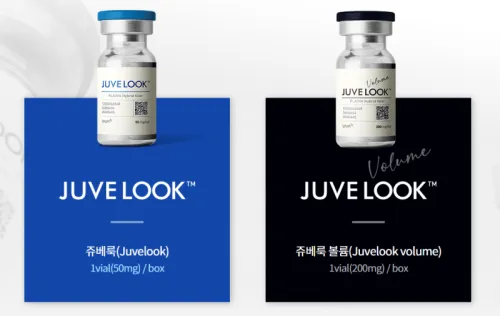
They share the same name. They come from the same Korean manufacturer. They use the same two core ingredients. And yet, Juvelook and Juvelook Volume are not the same treatment — not even close. Confusing them is one of the most common mistakes people make when researching Korean injectable treatments, and choosing the wrong one means either underwhelming results or, at worst, product placed in the wrong tissue layer entirely.
This guide untangles the juvelook vs juvelook volume question once and for all. We’ll cover exactly what makes them different, what each one actually does in the skin, how they compare to alternatives like Sculptra and traditional fillers, and — most importantly — how to figure out which one matches your skin goals right now.
Same Ingredients, Very Different Products
Both Juvelook and Juvelook Volume are manufactured by VAIM Global in South Korea. Both are FDA-approved, KFDA-approved, and CE-marked. Both combine two active ingredients: poly-D,L-lactic acid (PDLLA) and non-cross-linked hyaluronic acid (HA). The HA provides immediate hydration; the PDLLA biodegrades gradually while stimulating the skin’s fibroblasts to produce new collagen.
So if the ingredients are the same, what actually makes them different? Two things: PDLLA concentration and particle size. And those two differences change everything about how and where each product is used.
| Juvelook | Juvelook Volume (Lenisna) | |
|---|---|---|
| PDLLA | 42.5mg per vial | 170mg per vial (4× more) |
| HA | 7.5mg (non-cross-linked) | 30mg (non-cross-linked) |
| Particle size | ~30µm (small) | 50–80µm (larger) |
| Injection layer | Mid-to-deep dermis | Subcutaneous / supraperiosteal |
| Primary goal | Skin quality, glow, texture, pores | Volume, lift, structural support |
| Duration | 9–12 months | 12–24 months |
| Sessions | 2–3 sessions, 4–6 weeks apart | 1–3 sessions, 4–6 weeks apart |
| Also known as | Juvelook Skin | Lenisna (export name) |
What Juvelook Does: Skin Quality From the Inside Out
Juvelook’s smaller PDLLA particles (~30µm) are calibrated specifically for the dermis — the middle layer of the skin that governs texture, hydration, pore appearance, and fine lines. At this concentration and depth, the product improves what the skin looks and feels like without significantly changing your facial structure.
When Juvelook is injected into the mid-to-deep dermis, two things happen in sequence. First, the non-cross-linked HA delivers an immediate hydration boost — your skin starts looking dewier and more refreshed within days. Then, over the following weeks and months, the PDLLA microspheres gradually dissolve, triggering fibroblast activation and new collagen production. The result is skin that genuinely becomes firmer, smoother, and more even over time.
What Juvelook Treats Best
- 🌿 Fine lines and early wrinkles across the face and neck
- 🌿 Enlarged pores — as collagen density increases, pore walls become better supported
- 🌿 Shallow and rolling acne scars
- 🌿 Dull, dehydrated, or uneven skin tone
- 🌿 Under-eye area — texture, fine lines, and subtle hollowing
- 🌿 Overall skin glow and the coveted Korean “glass skin” effect
- 🌿 Neck and décolletage skin quality
The key characteristic of Juvelook is that it refines rather than reshapes. Someone treated with Juvelook will look healthier and more radiant — not different in structure. This is exactly why it suits younger patients (late 20s to early 40s) who have good facial volume but want better skin quality, and why it’s so popular as a preventive treatment rather than a corrective one.
What Juvelook Volume Does: Structure and Lift From Deeper Layers
Juvelook Volume (exported internationally as Lenisna) operates on an entirely different principle. Its larger PDLLA particles (50–80µm) and higher concentration (170mg) mean it cannot safely be injected into the dermis — the product is too dense for that layer. Instead, it’s designed for the subcutaneous fat layer or supraperiosteal plane, where it delivers structural volumising and a genuine lifting effect.
At these deeper tissue levels, Juvelook Volume works more like a collagen-stimulating filler than a skin booster. It restores the volume that has been lost from facial fat compartments over time, improves the structural support that keeps the midface elevated, and softens deep folds and contour changes that Juvelook simply cannot reach.
What Juvelook Volume Treats Best
- 🔷 Hollow cheeks and midface volume loss
- 🔷 Deep nasolabial folds (smile lines)
- 🔷 Marionette lines
- 🔷 Temple hollowing
- 🔷 Jawline definition and early jowling
- 🔷 Skin laxity requiring structural support
- 🔷 Deep acne scars
- 🔷 Body skin laxity (abdomen, arms, knees)
One important nuance: Juvelook Volume should generally not be used in very delicate areas like the under-eye zone where Juvelook (standard) excels. The higher concentration and larger particle size make it unsuitable for superficial, thin-skin areas. This is precisely why both products exist — each covers the tissue layer the other cannot safely address.

Juvelook Volume vs Sculptra: How Do They Compare?
Juvelook Volume and Sculptra (poly-L-lactic acid, PLLA) are frequently compared because they occupy similar territory — both are collagen biostimulators that restore deeper facial volume over time. But they differ in important ways that matter for real-world treatment decisions.
Ingredient Difference: PDLLA vs PLLA
Sculptra uses PLLA — poly-L-lactic acid — which has a crystalline, irregular particle structure. Juvelook Volume uses PDLLA — poly-D,L-lactic acid — which produces spherical, porous, smooth particles. This structural difference is significant: PDLLA’s rounder particles integrate more smoothly into tissue, reduce the risk of nodule formation, and — critically — any nodules that do occur can often be flattened using radiofrequency heat. With Sculptra’s crystalline particles, nodule management is less straightforward.
HA Component
Juvelook Volume includes non-cross-linked HA, which provides immediate hydration and some initial plumping effect. Sculptra contains no HA — its results are purely from collagen stimulation with no immediate visible effect. This means Juvelook Volume offers earlier patient satisfaction while Sculptra requires more patience before any change is visible.
Massage Requirement
Sculptra famously requires post-treatment facial massage (the “5-5-5 rule”) to prevent product clumping and nodule formation. Because Juvelook Volume’s spherical PDLLA particles distribute more evenly on injection, this intensive post-treatment massage is not required — though gentle massage may still be advised for some patients.
Cost
Juvelook Volume (Lenisna) is significantly more affordable per vial than Sculptra — some practitioners estimate it costs less than a third of the equivalent Sculptra volume. Given comparable clinical outcomes for the right patient, this cost difference has made Juvelook Volume the preferred choice at many Korean and Asian clinics that previously used Sculptra routinely.
Duration
Sculptra’s collagen-stimulating effects can last up to two years or more. Juvelook Volume results similarly last 12–24 months, with some studies suggesting even longer in certain cases. The durations are broadly comparable, making cost and safety profile the more significant differentiators.
Juvelook Volume vs Filler: Why It’s Not the Same Thing
This is perhaps the most important misconception to address: Juvelook Volume is not a traditional filler, and treating it as one will lead to unrealistic expectations on both sides.
Traditional HA fillers (Juvederm, Restylane, etc.) add immediate, mechanical volume. You inject them into a space, they physically occupy that space, and you walk out of the clinic looking different. The volume is there immediately. That’s also its limitation — HA fillers are temporary (6–18 months), carry risks of migration and cumulative buildup, and can look unnatural if overfilled.
Juvelook Volume works differently. Its HA component provides some immediate hydration and subtle plumping, but the meaningful volumising effect comes from the collagen your skin builds over weeks and months in response to the PDLLA. This means:
- ✔️ Results are gradual and natural-looking — no sudden “filled” appearance
- ✔️ No risk of the product migrating or accumulating over time
- ✔️ After 2 years, no residue has been detected in tissue — fully biodegradable
- ✔️ Can be repeated safely and layered without the accumulation risks of cross-linked HA
- ❌ Not appropriate for immediate structural correction before a major event
- ❌ Not suitable for very precise volumising (e.g., exact lip border definition)
Think of traditional fillers as renting volume, and Juvelook Volume as investing in collagen infrastructure that your body builds and owns. For patients who want to avoid looking “done” but still want meaningful facial improvement, Juvelook Volume is often the more appealing option. For those who need instant, specific structural correction, traditional fillers or combined approaches remain appropriate.
Can You Use Juvelook and Juvelook Volume Together?
Yes — and many Korean dermatologists combine them in a single treatment protocol. Because Juvelook targets the dermis and Juvelook Volume targets the subcutaneous layer, they address different tissue depths simultaneously without competing or interfering with each other.
A layered approach might look like this: Juvelook Volume is injected into the deep layer of the cheeks and temples to restore structural volume and lift, while standard Juvelook is then injected into the dermis of the same and adjacent areas to improve skin quality, hydration, and texture across the surface. The result is a comprehensive treatment that delivers both glow and contour — which neither product achieves alone to the same degree.
For a detailed exploration of the Juvelook and Lenisna (Juvelook Volume) combination and how the two products complement each other at the tissue level, Juvelook Lenisna: The Complete Guide to Korea’s Most Powerful Collagen Biostimulator Duo covers the full picture.
Who Should Choose Juvelook?
Juvelook is the right choice if:
- ✔️ Your main concern is skin quality — texture, dullness, pores, fine lines, or early ageing
- ✔️ You have good facial volume but skin that looks tired or textured
- ✔️ You want improvement in the under-eye area, crow’s feet, or neck
- ✔️ You’re in your late 20s to early 40s and focused on prevention and maintenance
- ✔️ You want gradual, subtle results that don’t change your facial structure
Browse and shop Juvelook here before your clinic consultation.
Who Should Choose Juvelook Volume?
Juvelook Volume is the right choice if:
- ✔️ You have visible volume loss — hollow cheeks, sunken temples, early jowling
- ✔️ Deep folds like nasolabial lines or marionette lines are a primary concern
- ✔️ You want structural lifting without surgery
- ✔️ You’re in your 40s, 50s, or beyond and dealing with real collagen and fat loss
- ✔️ You want longer-lasting results (up to 24 months) and fewer maintenance sessions
- ✔️ You want an alternative to traditional fillers with no overfilled risk
Browse and shop Juvelook Volume here.
Results Timeline: What to Expect From Each
Juvelook Timeline
- Days 1–5: Immediate hydration glow from HA; mild redness and small injection-site bumps resolve
- Weeks 2–4: Skin starts to feel softer and more even; initial collagen stimulation begins
- Months 2–3: Visible improvement in texture, pore size, and skin firmness
- Month 4+: Full results established; lasts 9–12 months before maintenance is needed
Juvelook Volume Timeline
- Days 1–7: Some immediate subtle plumping from HA; mild swelling may be more pronounced than with standard Juvelook
- Weeks 3–6: Structural improvement begins as collagen forms in treated areas
- Months 2–4: Lifting and volumising effects become clearly visible
- Month 6+: Peak results; lasts 12–24 months depending on patient, area, and number of sessions
The patience required for Juvelook Volume is worth noting — patients who expect immediate dramatic change (as with traditional fillers) may be surprised by the gradual timeline. Understanding this upfront prevents disappointment and aligns expectations correctly.
Safety: Is One Safer Than the Other?
Both products share the same core safety profile — biodegradable, no permanent residue, and a strong clinical safety record across over 1.5 million vials sold worldwide. The key safety difference is technique dependency.
Juvelook Volume requires deeper injection, larger volumes per session, and more precise anatomical knowledge of the facial fat compartments. Placing it too superficially increases nodule risk. For this reason, choosing a practitioner with documented experience specifically in Juvelook Volume injection technique is even more important than it is for standard Juvelook.
For a comprehensive breakdown of both products’ side effects — from mild and expected to rare and serious — Juvelook Side Effects: The Complete, Honest Guide Before You Book provides everything you need to know before any session.
For broader scientific context on how polylactic acid biodegrades in the body, the Wikipedia article on polylactic acid offers neutral, factual background on the chemistry underlying both treatments.
The Bottom Line: Juvelook vs Juvelook Volume
The cleanest way to remember the difference: Juvelook improves your skin, Juvelook Volume improves your structure.
If your skin looks dull, textured, or tired — but your face still has its youthful volume and shape — Juvelook is almost certainly the right starting point. If your face has lost volume and lift over time and you’re dealing with hollows, folds, or sagging that surface-level treatments can’t fix, Juvelook Volume (Lenisna) addresses the structural layer that Juvelook cannot reach.
Many patients — particularly those in their mid-40s and beyond — benefit from both, used together as a layered protocol. This comprehensive approach is exactly what makes the VAIM PDLLA system so appealing: two products, two layers, one complete anti-ageing strategy.
If you want to understand how either treatment compares to other popular Korean options before deciding, Rejuran vs Juvelook: The Honest Comparison You’ve Been Looking For is the most useful next read. And for full global pricing on both Juvelook and Juvelook Volume, Juvelook Price: The Complete Guide to What You’ll Actually Pay in 2025 covers everything. For the complete deep-dive on Juvelook as a collagen skin booster, Juvelook Collagen Skin Booster: Everything You Need to Know Before Your First Treatment is the essential resource.
Disclaimer: This post is for informational purposes only and does not constitute medical advice. Always consult a qualified medical professional before undergoing any injectable treatment.